MapleDeploy vs AWS
AWS gives you the parts. MapleDeploy gives you a managed server to deploy on.
AWS is a US cloud provider with two Canadian regions: Canada (Central) in Montreal and Canada West in Calgary. You build your hosting from its services, usually an EC2 server or Elastic Beanstalk for the app and RDS for the database. MapleDeploy is one layer up. You get a dedicated Toronto VM with Coolify on it, and we look after the server. This page covers what each one leaves to you, what it costs, and how the jurisdiction compares.
Side by side
What you get
- AWS
- Separate services you combine: EC2, Elastic Beanstalk, RDS and more
- MapleDeploy
- Dedicated VM with your own Coolify instance
Server administration
- AWS
- You, on EC2; Elastic Beanstalk applies minor and patch platform updates weekly
- MapleDeploy
- Handled for you
Deploy platform
- AWS
- Elastic Beanstalk or ECS Express Mode, or your own tooling on EC2
- MapleDeploy
- Coolify, installed and updated
Databases
- AWS
- RDS, billed as its own service, or self-run on EC2
- MapleDeploy
- One-click, included
Backups
- AWS
- EBS snapshots and AWS Backup, set up and billed by you
- MapleDeploy
- Weekly full-server snapshots included
Canadian locations
- AWS
- Montreal (ca-central-1), Calgary (ca-west-1)
- MapleDeploy
- Toronto
Customer contract
- AWS
- Amazon Web Services Canada, Inc., under Ontario and Canadian law
- MapleDeploy
- Ontario business, under Ontario law
Headquarters
- AWS
- United States
- MapleDeploy
- Canada
Pricing
- AWS
- Usage-based, per service; t3.medium about $34 USD/mo on demand
- MapleDeploy
- From $45 CAD/mo, server upkeep included
When AWS is the right choice
AWS is the right call when you need its breadth. It has managed services for almost every job, from queues and object storage to managed Kubernetes, and two Canadian regions, so you can build failover without leaving the country.
If your team already knows AWS, has credits, or needs a service only AWS runs, that is a real reason to stay.
What running on AWS leaves to you
AWS's shared responsibility model draws the line clearly. On EC2, the customer manages the guest operating system, including updates and security patches, the software installed on the instance, and its security group firewall. AWS runs the hardware, the network and the virtualization underneath.
Elastic Beanstalk takes on more. It deploys your code to EC2 for you, at no charge beyond the resources it creates, and its managed platform updates apply minor and patch updates in a weekly maintenance window. Moving to a new platform branch, such as a new operating system or runtime version, is still yours to plan and run.
AWS App Runner, its simpler container service, has no Canadian region and is closed to new customers. AWS points new users to Amazon ECS Express Mode, which runs in both Canadian regions at no charge beyond the Fargate, load balancer and other resources it creates. It deploys a container image, so building that image from your code on each push takes a CI pipeline you set up.
The rest is assembly. A database is a separate RDS service. Backups are EBS snapshots or AWS Backup plans you configure. Each one is another bill and another console page to watch. We walk through the trade in self-hosting Coolify vs managed Coolify.
What MapleDeploy handles
MapleDeploy runs the server and Coolify together. You get a dedicated VM in Toronto, ready in minutes, and you deploy through the Coolify dashboard.
- Security hardening. SSH key authentication, fail2ban, outbound SMTP blocking, and automatic security patches, applied before you first log in.
- OS patches. Operating system updates and kernel patches are applied for you. When a kernel update needs a reboot, it happens in a fixed 07:50 UTC window.
- Coolify itself. We run a public fork of Coolify that we rebase regularly against upstream. Changes are limited to Canadian branding and MapleDeploy integrations.
- Snapshots. Weekly full-server snapshots covering the OS, Coolify, containers, volumes and databases.
Snapshots are disaster recovery, not granular restores. For production databases, you should still set up Coolify's S3 database backups on a daily schedule.
Comparing the cost
AWS bills each service by use. A burstable t3.medium EC2 instance, with 2 vCPUs and 4 GiB of memory, is listed at $0.0464 USD an hour on demand in Canada (Central). That is about $34 USD a month for the server alone. Storage, data transfer, a database and backups are billed on top, each at its own rate.
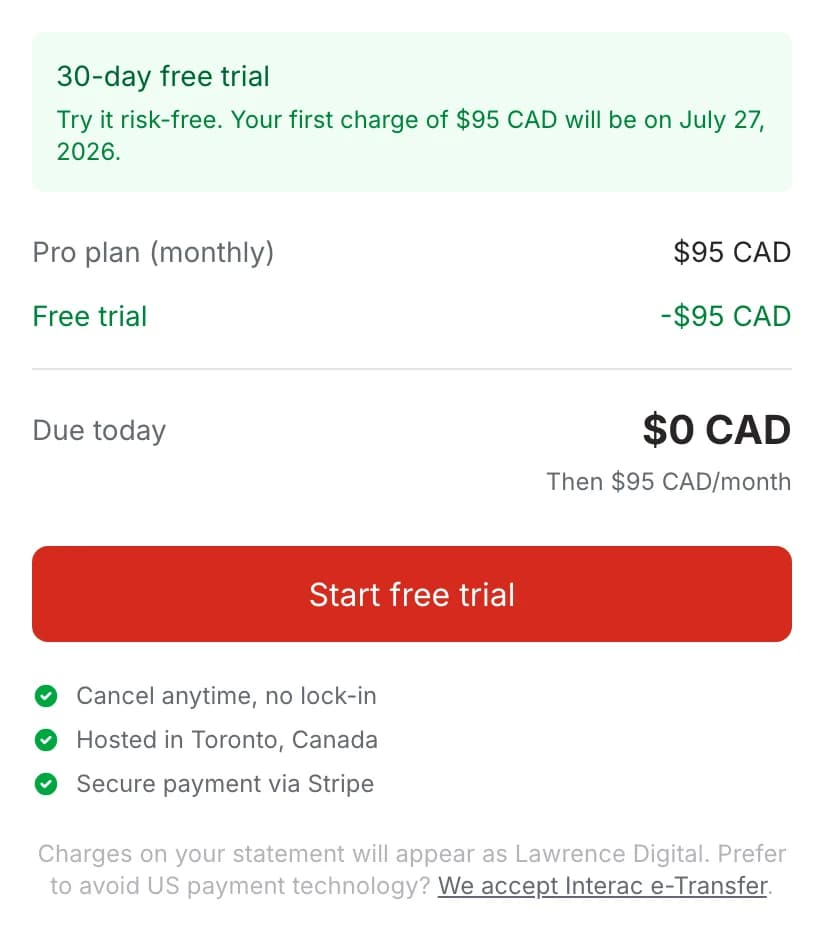
MapleDeploy starts at $45 CAD/month for a dedicated VM with 4 GB RAM, 2 vCPUs and 35 GB of storage. Databases, Coolify, patches and snapshots are in that price, with no per-project or usage fees. Starter and Pro include a 30-day free trial.
If you already run AWS well, adding a server there may cost you less. If you'd rather have one bill and no servers to run, the flat price is simpler.
Jurisdiction
Both options can host your data in Canada. Canadian AWS customers contract with Amazon Web Services Canada, Inc., under the laws of Ontario and Canada. AWS itself is a US company.
That distinction matters to some teams and not to others. Jurisdiction follows the company, not the data centre, which is why US providers with Canadian regions remain subject to the CLOUD Act. We look at what an AWS Canadian region does and doesn't guarantee in is AWS ca-central-1 actually Canadian data residency?
MapleDeploy runs on Canadian infrastructure in Toronto, with a privately owned Canadian provider that has no US parent company. Your code and your data are hosted under Canadian jurisdiction, on infrastructure built for PIPEDA compliance, on every plan.
Try it free for 30 days
Start with $0 due today. Your first charge comes after the trial. One flat price, with the server's upkeep included.
Ready to stop assembling the stack?
Coolify on a dedicated Toronto VM, patched and backed up for you.