MapleDeploy vs Railway
Canadian infrastructure with dedicated resources and flat pricing. Same developer experience, different jurisdiction.
Railway is a solid developer platform. Fast deploys, easy Postgres provisioning, a clean workflow. As a Canadian alternative to Railway, MapleDeploy offers the same git push experience on top of Coolify, with a dedicated VM instead of shared containers. This page breaks down the differences in jurisdiction, resource isolation, and pricing.
Side by side
Architecture
- Railway
- Containers on shared infrastructure
- MapleDeploy
- Dedicated VM per customer
Data residency
- Railway
- US jurisdiction (EU/Asia available)
- MapleDeploy
- Canadian jurisdiction
Databases
- Railway
- Included, resource usage metered
- MapleDeploy
- Included, deploy as many as you need
Egress
- Railway
- Billed per GB
- MapleDeploy
- Included
Infrastructure
- Railway
- US/EU/Asia (bare metal)
- MapleDeploy
- Canada (Toronto)
PIPEDA compliance
- Railway
- No Canadian-specific infrastructure
- MapleDeploy
- Designed to support compliance (SLA, breach notification)
Backups
- Railway
- Volume-level backups (manual or scheduled, daily/weekly/monthly options)
- MapleDeploy
- Weekly full-server snapshots included, 30-day retention after cancellation
Platform source
- Railway
- Proprietary
- MapleDeploy
- Open source (Coolify)
Pricing
- Railway
- Per-resource (free plan with $1/mo of usage credit; CPU, RAM, egress metered separately; a typical backend + database runs $40-80 USD/mo)
- MapleDeploy
- From $45 CAD/mo (4 GB RAM dedicated VM, all resources included, no metering)
When Railway is the right choice
Railway is genuinely excellent for teams that want the fastest path from code to production and don't have data residency requirements. The developer experience is best-in-class. The UI is clean and thoughtful. Spinning up a service with a database takes minutes.
If your project doesn't handle Canadian personal data, doesn't need to answer compliance questionnaires, and your team values a polished managed platform over dedicated infrastructure, Railway is a strong choice. Usage-based pricing also works well for low-traffic projects where a flat rate would be overkill.
MapleDeploy makes more sense when you need Canadian jurisdiction, want predictable monthly costs regardless of traffic, or prefer dedicated resources over shared containers. Both platforms deploy from git. The difference is where your data lives and how you're billed for it.
The cost of per-resource billing
Railway offers a Free plan with $1 of monthly usage credit, enough for a small hobby app. The Hobby plan is $5 USD/month with $5 in credits, and the Pro plan is $20 USD/month with $20 in resource credits. Once you exceed your included credit, you pay $20/vCPU/month, $10/GB RAM/month, and $0.05/GB for outbound traffic. Those numbers sound modest in isolation. They add up quickly in practice.
A typical backend app on Railway might use 0.5 vCPU and 512 MB RAM at idle, but spike to 1 vCPU and 1 GB RAM under load. Add a Postgres database at another 0.5 vCPU and 1 GB RAM, and a worker process at a similar footprint. You are now looking at 2 vCPU and 2.5 GB RAM sustained, before you account for traffic spikes. That puts you at $45-65 USD/month in a typical month, more if you ship a post that goes viral or run a batch job.
The egress charge catches teams by surprise. $0.05/GB does not sound like much until your API is returning large payloads, your app serves image assets, or you move data between services. A moderate-traffic app transferring 100 GB/month adds $5 USD on top of resource usage. That is traffic you are already paying compute to generate.
MapleDeploy starts at $45 CAD/month for a dedicated 4 GB RAM, 2 vCPU VM. Deploy a backend, a database, a worker, and a staging environment on the same VM. Egress is included. RAM and CPU are yours, not shared and not metered. The bill is the same whether you deploy one service or ten.
Dedicated resources vs shared containers
Railway runs your services as containers on shared infrastructure. Resources are metered because multiple tenants share the same underlying hardware. That works well for Railway, and it works well for most projects most of the time. But it means you are subject to the behavior of other workloads on the same machines.
Noisy neighbor effects are real on shared container platforms. When another tenant saturates the host's disk I/O or memory bandwidth, your latency goes up. This is hard to debug because it does not appear in your application metrics. It looks like intermittent slowness with no clear cause.
MapleDeploy gives each customer a dedicated VM. Your 4 GB of RAM is not shared with anyone else. Your 2 vCPUs are not competing for time. When you benchmark your app or profile a slow query, the numbers reflect your workload, not the aggregate of whoever else happens to be on the host.
This also means predictable performance at deploy time. Container platforms can have cold start latency when spinning up new instances, particularly under traffic. A dedicated VM running Coolify keeps your services running continuously. No cold starts, no rescheduling delay, no slot availability waiting.
For most hobby projects and early-stage products, the difference will not matter. For production APIs with SLAs, latency-sensitive workloads, or anything where you need consistent baseline performance, dedicated resources are the safer choice. See our open-source stack for how Coolify manages services on your VM.
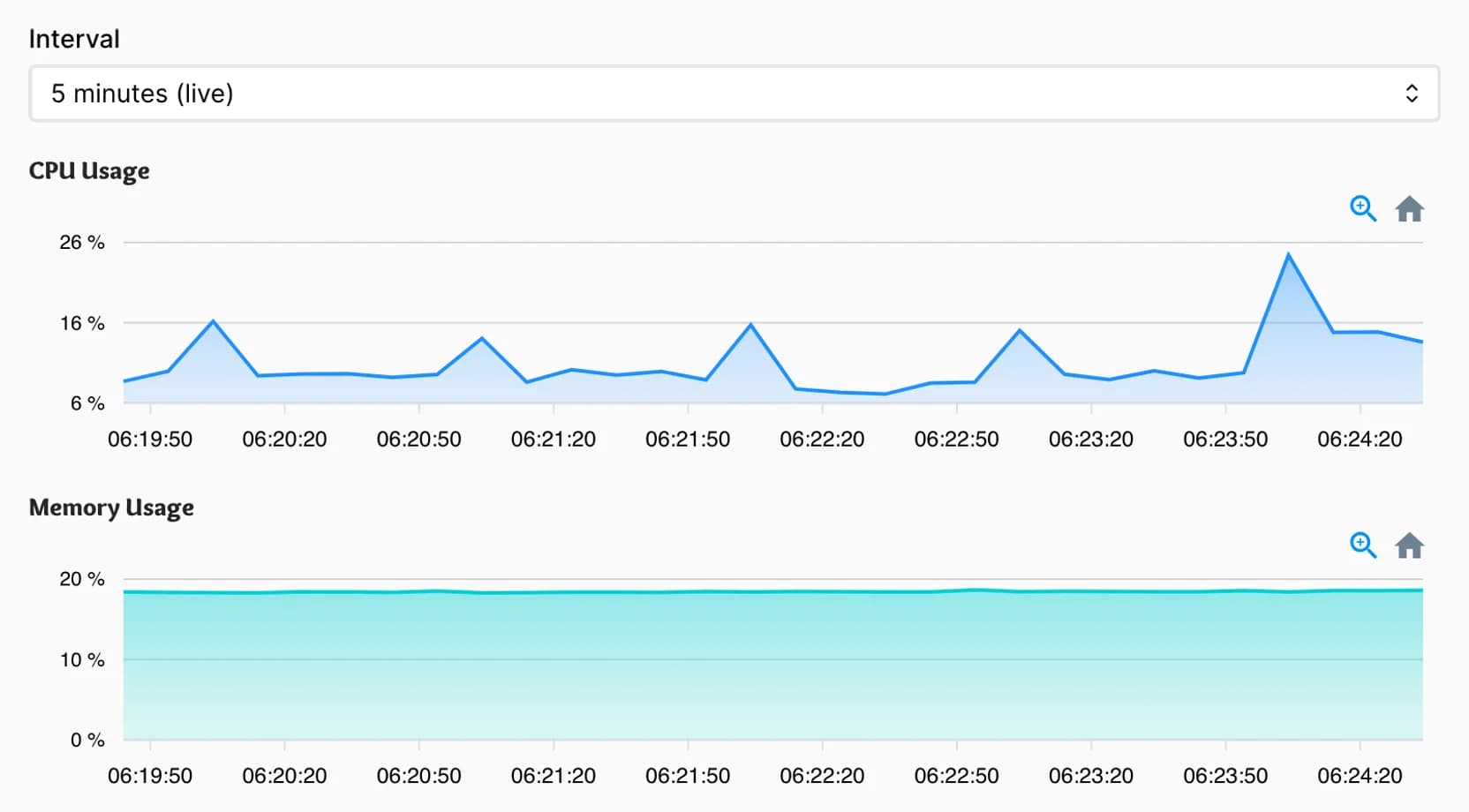
Your resources, fully visible
Monitor CPU and memory usage in real time. With a dedicated VM, these metrics reflect your workload alone. No guessing about noisy neighbors or shared resource contention.
Try it free for 30 days
Start with $0 due today. Your first charge comes after the trial. One flat price, no resource metering to worry about.

Ready to switch?
Same git push workflow you're used to. Canadian infrastructure, flat pricing, dedicated resources.