MapleDeploy vs Heroku
Dedicated Canadian infrastructure with flat pricing. No dynos, no add-on fees, no US jurisdiction.
Heroku pioneered the git push deploy workflow and remains a popular platform. But it's a Salesforce-owned, US-based service with no self-serve Canadian region, and pricing adds up quickly when you combine dynos, databases, and add-ons. MapleDeploy is the Canadian PaaS alternative to Heroku: a dedicated VM in Toronto with flat monthly pricing and the same git push experience.
Side by side
Add-ons and databases
- Heroku
- Marketplace with separate billing, databases from $5 USD/mo
- MapleDeploy
- Included, deploy what you need on your VM
Architecture
- Heroku
- Containers (dynos) on shared infrastructure
- MapleDeploy
- Dedicated VM per customer
Data residency
- Heroku
- US (Salesforce subsidiary); Canadian region only via Private Spaces (from $1,000 USD/mo)
- MapleDeploy
- Canada (Toronto) on every plan (SLA, compliance docs)
Backups
- Heroku
- Database backups included with Postgres add-on (billed separately); no full-server snapshots
- MapleDeploy
- Weekly full-server snapshots included, 30-day retention after cancellation
Platform source
- Heroku
- Proprietary
- MapleDeploy
- Open source (Coolify)
Pricing
- Heroku
- Per dyno + add-ons (from $7 USD/mo for 512 MB always-on container, databases extra; $5 USD/mo Eco pool with sleep)
- MapleDeploy
- From $45 CAD/mo (4 GB RAM dedicated VM, databases + SSL + deploys included)
Vendor lock-in
- Heroku
- Heroku CLI and platform (Cloud Native Buildpacks and Docker deploys also supported)
- MapleDeploy
- Standard Docker and git workflows
After Salesforce
Heroku pioneered the git push deploy workflow. For a long time, it was the fastest path from code to running app. That legacy is real and worth acknowledging.
In 2010, Salesforce acquired Heroku. Development pace slowed through the 2010s. In November 2022, Heroku removed its free tier entirely, with no equivalent replacement. Thousands of developers who had built side projects, open-source tools, and demos on Heroku's free dynos had about three months to find alternatives.
The platform continues to work, and it still has a large customer base. In February 2026, Heroku announced a move to a sustaining engineering model, prioritizing stability, security, and support over new features. Enterprise contracts are closed to new customers, though existing ones continue and can renew. Credit card customers, existing and new, keep the same pricing, billing, and service.
For developers evaluating where to host new projects, that changes the calculus. The free tier is gone, pricing has moved up, new development is scoped to stability and security rather than new capabilities, and Heroku is a Salesforce subsidiary with US data jurisdiction.
Many developers who left after 2022 landed on Railway, Render, or Fly. Those are US companies, so US jurisdiction follows your data regardless of where their servers sit. If Canadian data residency matters to you, either for PIPEDA compliance or on principle, none of them solve the jurisdiction problem. MapleDeploy does.
The real cost of a production Heroku stack
Heroku's pricing looks simple until you build something real. A single web dyno at the Basic tier is $7 USD/month. Add a worker dyno for background jobs: another $7. A Standard-1X dyno for horizontal scaling and zero-downtime deploys: $25. Standard-2X for more memory: $50. You need a database, so Postgres Essential-0 is $5/month and Essential-1 is $9. Throw in a scheduler add-on and a logging service, and you're looking at $80-150 USD/month before you've added any redundancy or staging environments.
A realistic production stack with a web dyno, worker, Standard-1X resources, Postgres, and a logging add-on sits comfortably at $100-200 USD/month. In Canadian dollars, that's $140-280 CAD at current exchange rates, and that's billed per resource with no ceiling.
MapleDeploy's Starter plan is a flat $45 CAD/month. Deploy as many apps, databases, and background workers as your VM can handle. See our pricing for what each plan includes.
Migrating from Heroku
If you're considering a move, the practical path is straightforward. Your Heroku app already builds from a git repo. MapleDeploy deploys the same way: push to a branch, the platform builds and deploys. If you have a Dockerfile, it works as-is. If you're using Heroku buildpacks, Coolify's Nixpacks builder handles most frameworks automatically.
The bigger shift is databases. Heroku Postgres add-ons are separate products with their own billing. On MapleDeploy, you provision PostgreSQL (or MySQL, Redis, MongoDB) directly on your VM. Use pg_dump to export from Heroku and pg_restore to import. Connection strings update in your environment variables.
For other add-ons, Coolify's one-click service marketplace covers the most common needs: databases, Redis, monitoring, logging, and more. You deploy them alongside your app on the same VM. For anything not in the marketplace, you can run any Docker image directly. The model is different from Heroku's third-party add-on ecosystem, but the coverage is broader than you might expect. Our getting started guide walks through the full process from signup to a live app.
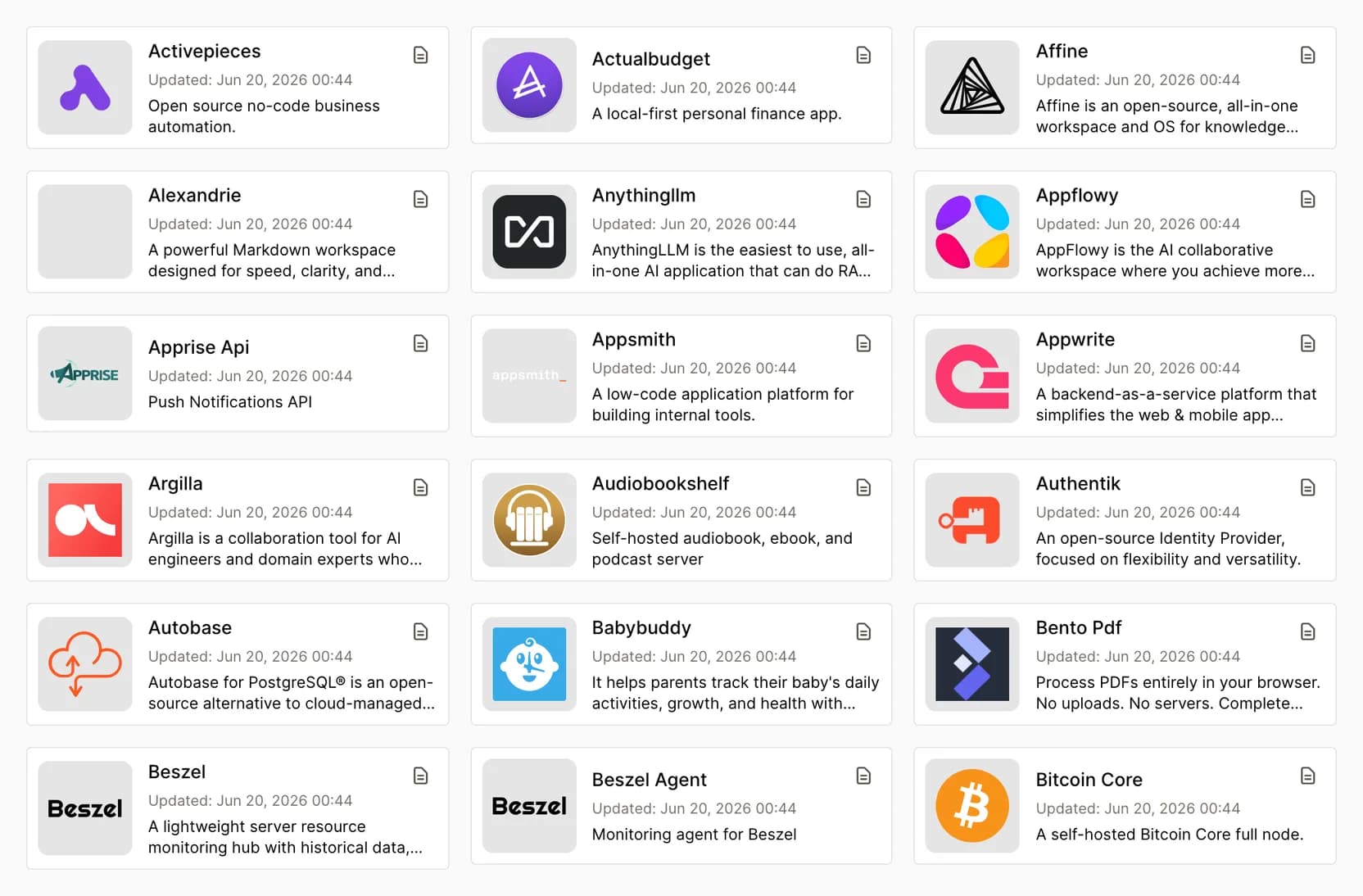
300+ one-click services
WordPress, Supabase, Grafana, N8N, Ollama, and more. Deploy pre-configured services alongside your app with one click. No third-party add-ons, no separate billing.
Try it free for 30 days
Start with $0 due today. Your first charge comes after the trial. One flat price, no add-ons to calculate.

Ready to switch?
Same git push deploys. Canadian infrastructure, flat pricing, dedicated resources, no add-on fees.