The Canadian SaaS Stack
A curated guide to building software on Canadian and non-US infrastructure. Tools, services, and alternatives for developers who care about where their data lives.
Building a credibly Canadian product means making deliberate choices about every service in your stack. This page lists Canadian-owned, Canadian-hosted, and non-US alternatives across the categories that matter most. Not everything has a perfect Canadian option. We're honest about the gaps.
Browse by category
Why this list exists
More procurement teams, compliance officers, and developers are asking the same question: is this service subject to the US CLOUD Act? If your hosting provider, email service, or database vendor is a US company, the answer is yes, regardless of where the data physically sits.
This list helps you find alternatives. Some categories have strong Canadian options. Others don't. We've noted the tradeoffs so you can make informed decisions.
For more context, see our guide on building your SaaS on Canadian infrastructure and our explanation of the CLOUD Act's impact on Canadian businesses.
Hosting and compute
Last reviewed: August 2026
LunaNode (Toronto, Canadian-owned)
Canadian cloud provider with VMs and block storage. Toronto data center. Canadian-owned, no US parent company. This is what MapleDeploy runs on.
Vexxhost (Montreal, Canadian-owned)
OpenStack public cloud from a Montreal company operating since 2005. Per-minute billing, public cloud egress at $0.10 per GB with free transfer on private platforms and Ceph, plus Kubernetes and bare metal. They also run regions in Santa Clara and Amsterdam, so pick the Montreal region for Canadian residency.
Patrii Cloud (Montreal, Canadian-owned)
New Canadian sovereign cloud built on open source (OpenStack, Ceph). Montreal data center, VPS from $5.25 CAD/month with no bandwidth charges within Canada. Still early: the service is in beta and compliance certifications are planned, not yet in place.
OVH Canada (Beauharnois QC, French parent)
Large European cloud provider with Canadian data centers in Beauharnois, Quebec (near Montreal) and the Toronto area. French-headquartered (OVHcloud), outside US jurisdiction. Good option for compute and dedicated servers.
DigitalOcean (Toronto region, US-owned)
Has a Toronto region, but DigitalOcean is a US company subject to the CLOUD Act. Geography is Canadian, jurisdiction is not. See our DigitalOcean comparison for details.
Deployment platforms
Last reviewed: August 2026
MapleDeploy (Toronto, Canadian-owned)
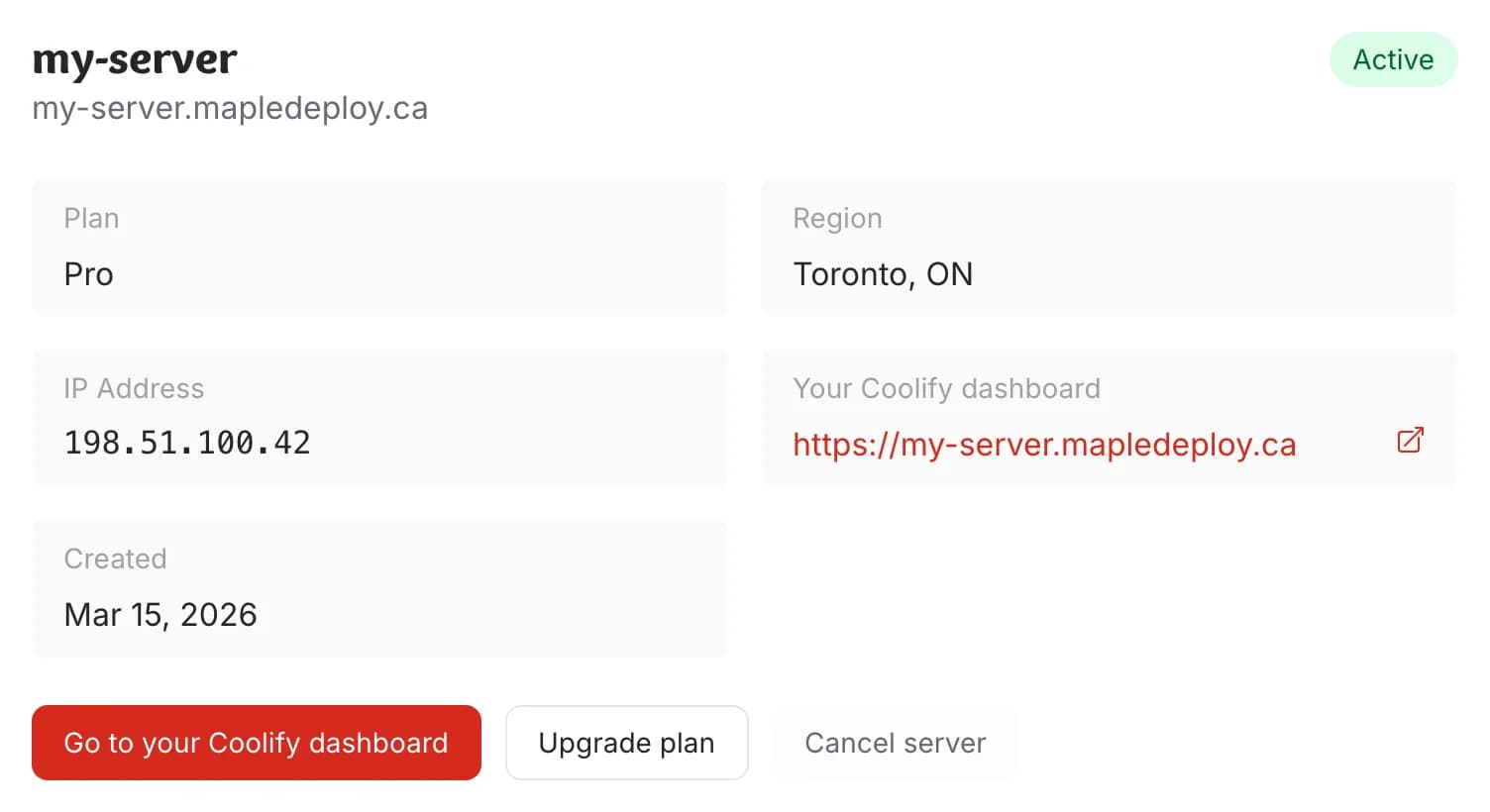
Managed Coolify hosting on dedicated Canadian infrastructure. Git push deploys, one-click databases, flat pricing starting at $45 CAD/month. Canadian jurisdiction, no US CLOUD Act exposure.
Coolify (open source, self-hosted)
Open-source deployment platform you run on your own server. Pair with a Canadian VPS provider like LunaNode for Canadian data residency with full control. Free, but you manage the infrastructure.
Dokploy (open source, self-hosted)
The next most popular open-source deployment platform after Coolify, launched in 2024. Deploys applications, databases, and Docker Compose stacks, with Docker Swarm support for multi-node setups. Self-host it on a Canadian VPS for data residency. See our Coolify vs Dokploy comparison for a side-by-side breakdown.
Last reviewed: August 2026
Cakemail (Montreal, Canadian-owned)
Transactional and marketing email based in Montreal. Canadian-owned. A genuine alternative to SendGrid and Mailgun for teams that need Canadian email infrastructure.
Zedmail (Ottawa, Canadian-owned)
Transactional email API with REST and SMTP support, hosted in Canada. No US parent company, no CLOUD Act exposure. Priced to compete with Amazon SES.
MailChannels (Vancouver, Canadian-owned)
Transactional email API from a Vancouver company that has delivered email for hosting providers since 2004. REST and SMTP support, free up to 3,000 emails a month, then volume pricing. A high-volume Canadian sender.
Mailbox.org (Germany)
Business email hosting based in Germany. GDPR-compliant, outside US jurisdiction. Not Canadian, but a solid non-US alternative to Google Workspace and Microsoft 365 for business email.
The gap
High-volume transactional email is the thinnest category, but less so than it used to be. MailChannels handles serious volume, Zedmail is a newer Canadian entrant, and Cakemail covers most marketing and transactional use cases. Enterprise-volume senders should still evaluate deliverability and scale before committing.
Payments
Last reviewed: August 2026
Helcim (Calgary, Canadian-owned)
Canadian payment processor with interchange-plus pricing and a solid API. Works well for most SaaS businesses. Their acceptable use policy prohibits website hosting when it is the sole service offering, and restricts it when it is part of a larger offering, which is why MapleDeploy uses Stripe instead. Check their acceptable use policy to confirm your business category fits.
Stripe (US-owned)
The industry standard. Stripe is a US company, so payment data crosses the border. For businesses that Helcim supports, Helcim is the stronger sovereignty choice. We use Stripe because Helcim classifies hosting as restricted. See why we use Stripe for the full explanation.
The gap
Helcim is a credible Canadian option for most SaaS businesses, but no Canadian processor yet matches Stripe's subscription lifecycle tooling or global coverage. If your business category is supported, Helcim works. If not, Stripe is the practical fallback.
CDN and DNS
Last reviewed: August 2026
Bunny.net (Slovenia, EU-headquartered)
CDN and DNS provider based in Slovenia. GDPR-compliant, outside US jurisdiction. Edge delivery worldwide with European data governance. This is what MapleDeploy uses for DNS and CDN.
CIRA Canadian Shield (Canadian non-profit)
Privacy-respecting DNS operated by the Canadian Internet Registration Authority. No tracking, no data selling. Fully Canadian. Good for recursive DNS, not a CDN.
Analytics
Last reviewed: August 2026
Umami (open source, self-hosted)
Privacy-focused web analytics you host yourself. No cookies, GDPR-compliant by design. Deploy on your Canadian server for fully sovereign analytics.
Plausible (EU-headquartered)
Lightweight, privacy-focused analytics based in the EU. Cloud-hosted on EU infrastructure or self-hostable. A clean alternative to Google Analytics.
Fathom Analytics (Canadian-founded)
Privacy-first analytics founded by Canadian developers. EU isolation processes and anonymizes EU visitors' personal data in the EU, but the anonymized analytics data is stored on US infrastructure. Good balance of simplicity and compliance.
Monitoring and observability
Last reviewed: August 2026
Better Stack (Prague-based, US-incorporated)
Uptime monitoring, incident management, and log management. Team is based in Prague, but the company is incorporated in the US as Better Stack, Inc. Similar jurisdiction tradeoff to using any US entity.
Hyperping (Paris, French-owned)
Uptime monitoring, status pages, and on-call from a bootstrapped French company with EU data storage. Free tier with 20 monitors. Not Canadian, but a real non-US alternative to US-incorporated monitoring services.
Grafana + Prometheus (open source, self-hosted)
Self-hosted monitoring stack. Run it on your Canadian server for fully sovereign observability. Requires ops investment to maintain.
The gap
There is no Canadian-owned monitoring SaaS comparable to Datadog or New Relic. Self-hosting with open-source tools or using EU-based services are the practical alternatives.
Databases
Last reviewed: August 2026
Self-managed on Canadian infrastructure
PostgreSQL, MySQL, Redis, and MongoDB are all open-source and can run on any Canadian server. MapleDeploy includes one-click database provisioning on your dedicated VM.
OVHcloud Managed Databases (Beauharnois QC, French parent)
Managed PostgreSQL, MySQL, and MongoDB in OVHcloud's Beauharnois, Quebec data center. French-headquartered, outside US jurisdiction. Pricier than self-managed, but the closest thing to a managed database service on Canadian soil without a US provider.
The gap
There is no Canadian-owned managed database service comparable to PlanetScale, Neon, or Supabase. OVHcloud's managed databases in Quebec are the closest non-US option. Otherwise, self-managed databases on Canadian compute remain the practical approach.
Object storage
Last reviewed: August 2026
eazyBackup e3 (Saskatoon, Canadian-owned)
S3-compatible object storage from a Canadian company. Data stored in Ottawa in a facility registered under the Government of Canada Controlled Goods Program. This is what MapleDeploy uses for database backups. Works with Coolify's built-in S3 backup feature out of the box.
OVHcloud Object Storage (Beauharnois QC, French parent)
S3-compatible object storage available in OVHcloud's Beauharnois, Quebec data center. French-headquartered, outside US jurisdiction. No egress fees, which is a significant advantage over AWS S3.
Self-hosted on Canadian infrastructure
Run S3-compatible storage on your own Canadian server. Pairs with any Canadian VPS provider for full data residency and control over your file storage.
Authentication
Last reviewed: August 2026
Zitadel (Swiss-founded, US-headquartered)
Open-source identity management built for multi-tenant SaaS. Founded in Switzerland, but the company is now US-headquartered and its managed cloud runs on Google Cloud. Supports OIDC, OAuth 2.0, SAML, MFA, and passkeys. Self-host it on Canadian infrastructure for sovereign auth.
Keycloak (open source, self-hosted)
Full-featured identity provider, a CNCF incubating project originally built by Red Hat. Supports OIDC, SAML, social login, MFA, and user federation. Self-host on a Canadian server for complete data residency. Operationally heavier than lighter alternatives, but very capable.
The gap
There is no Canadian-owned authentication service. Auth0, Clerk, and Cognito are all US-owned, and Zitadel is now US-headquartered too. Self-hosting Zitadel or Keycloak on Canadian infrastructure gives you data residency for user credentials and sessions.
Version control and CI/CD
Last reviewed: August 2026
Honest about the gaps
A fully Canadian stack is not possible today. The practical approach is to be deliberate: use Canadian or EU services where strong options exist, and make informed tradeoffs where they don't.
How MapleDeploy fits
MapleDeploy is the deployment and hosting layer of this stack. We provision and manage Coolify instances on LunaNode in Toronto. Your apps, databases, and files live on a dedicated VM under Canadian jurisdiction.
You still need to evaluate every other service in your stack. But if the foundation is Canadian, the rest of the decisions get easier.
Start with the foundation
Canadian hosting with flat pricing. 30-day free trial, plans starting at $45 CAD/month.