MapleDeploy vs Vercel
Dedicated Canadian hosting with flat pricing. From Next.js sites to full-stack apps, one platform.
Vercel is a leading deployment platform for frontend frameworks, especially Next.js. It's optimized for edge delivery and serverless functions. As a Canadian alternative to Vercel, MapleDeploy is a dedicated VM on Canadian infrastructure with flat monthly pricing. Both deploy websites and Next.js applications. The differences are jurisdiction, pricing model, and what else you can run on the same platform.
Side by side
Bandwidth
- Vercel
- Metered beyond plan limits
- MapleDeploy
- Included
Best for
- Vercel
- Stateless web apps, frontend frameworks, and HTTP services
- MapleDeploy
- Any workload (web apps, APIs, databases)
Data jurisdiction and ownership
- Vercel
- US company, US law (CLOUD Act applies). Montreal region available for function execution, but jurisdiction follows the company.
- MapleDeploy
- Canadian-owned and operated (SLA, compliance docs)
Databases
- Vercel
- Add-on services, usage-billed
- MapleDeploy
- One-click, included
Deploys
- Vercel
- Git push (frontend, functions, and Dockerfile containers)
- MapleDeploy
- Git push (any Dockerfile or buildpack)
Backups
- Vercel
- No server backups (serverless, stateless). Database backups depend on marketplace provider.
- MapleDeploy
- Weekly full-server snapshots included, 30-day retention after cancellation
Platform source
- Vercel
- Proprietary
- MapleDeploy
- Open source (Coolify)
Pricing
- Vercel
- $20 USD/mo base + $20/additional seat + usage fees (databases and storage are usage-billed add-ons)
- MapleDeploy
- From $45 CAD/mo (4 GB RAM dedicated VM, databases + full-stack included, no per-seat fees)
Type
- Vercel
- Serverless platform (stateless compute)
- MapleDeploy
- Managed PaaS (full-stack)
The serverless tradeoff
Vercel is genuinely excellent at what it's designed for: deploying static sites and Next.js apps with a global edge network and zero server management. If your entire stack lives in serverless functions and you have no persistent state, the model works well.
The friction shows up when your application grows. Vercel has filled in much of what serverless used to rule out. Cron jobs, queues, durable workflows, and WebSockets in public beta all run natively now, and a Dockerfile deploys on Fluid compute alongside the functions. What stays true is the state itself. Vercel's own docs put it plainly: you can't run your own Postgres or Redis container with local disk, so persistent state lives in a backing service you attach. Cold starts are much reduced with Fluid compute and function pre-warming, though they can still occur during traffic spikes or for infrequently-used routes. Vercel's caching and routing layer is tuned to its own infrastructure, so moving to another host means re-tuning that layer.
MapleDeploy runs a standard server process. Your Next.js app, a background job worker, a PostgreSQL database, a Redis cache, they all run on the same VM under your control, deployed via Docker or buildpacks. There are no function timeouts, no cold starts, and no proprietary abstractions to unwind if your needs change. The open-source Coolify layer is the only platform-specific interface, and Coolify itself is portable.
The honest summary: if you need a global edge network and your workload is purely frontend-plus-serverless, Vercel is hard to beat. If you need full-stack flexibility, Canadian data residency, or predictable flat pricing as your team and project count grow, MapleDeploy is worth the comparison.
Running Next.js outside Vercel
A common concern: does Next.js work well outside Vercel? Yes. Next.js is an open-source framework that runs anywhere Node.js runs. Vercel adds a global edge network, its own caching layer, and an image optimization CDN. The framework features behind them, ISR, middleware, and next/image, run self-hosted too.
On MapleDeploy, Next.js deploys via git push with automatic detection. Server-side rendering, API routes, and dynamic pages all work. You get a dedicated server in Toronto with predictable performance and no per-request billing. Vercel adds a global edge network and proprietary caching on top, but the core framework runs the same.
The tradeoff: Vercel's edge network distributes static content across global points of presence, which helps if your users are spread worldwide. MapleDeploy serves from Toronto, which means strong performance across Canada and the US northeast. If you need global edge caching, adding a CDN like Bunny.net or Cloudflare in front of your MapleDeploy server closes that gap, while keeping your origin and data in Canada.
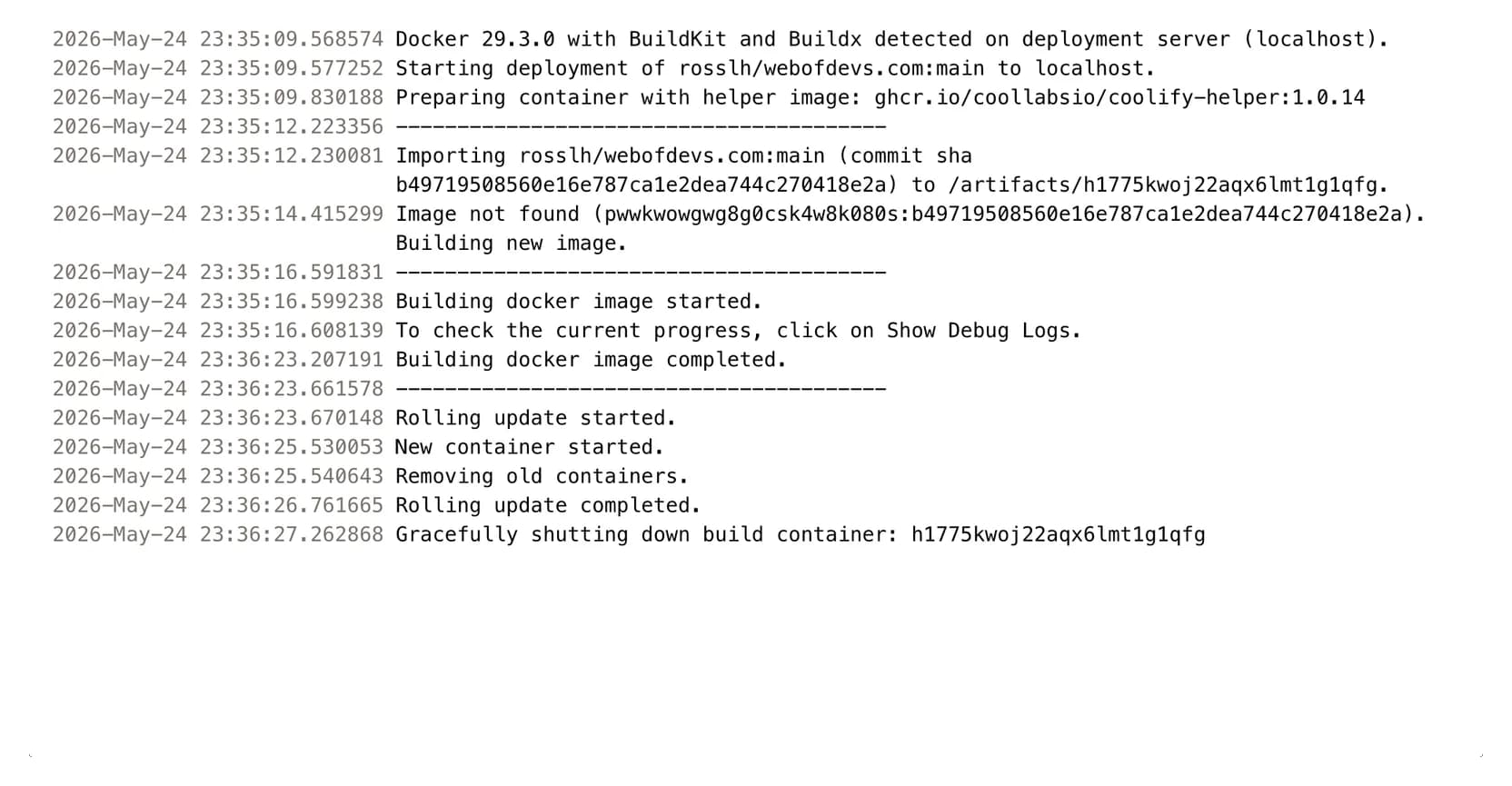
See every build step
Real-time deployment logs show exactly what's happening. Docker image builds, container rollouts, and timestamped steps. No black-box deploys.
Agencies and multi-project teams
If you're managing multiple Next.js sites or client projects, the pricing models diverge fast. On Vercel, bandwidth and serverless function usage are metered across all projects and billed beyond included allocations, and each additional deploying team member is $20 USD/month.
Consider a small agency with five developers and twenty client sites. At Vercel Pro, that's $20 USD platform fee plus $80 USD for the four additional deploying seats, so $100 USD/month. That includes 1 TB of bandwidth and a $20 usage credit, but function invocations and storage for each project add up from there. In CAD at typical exchange rates, you're looking at $140 or more each month just in platform fees.
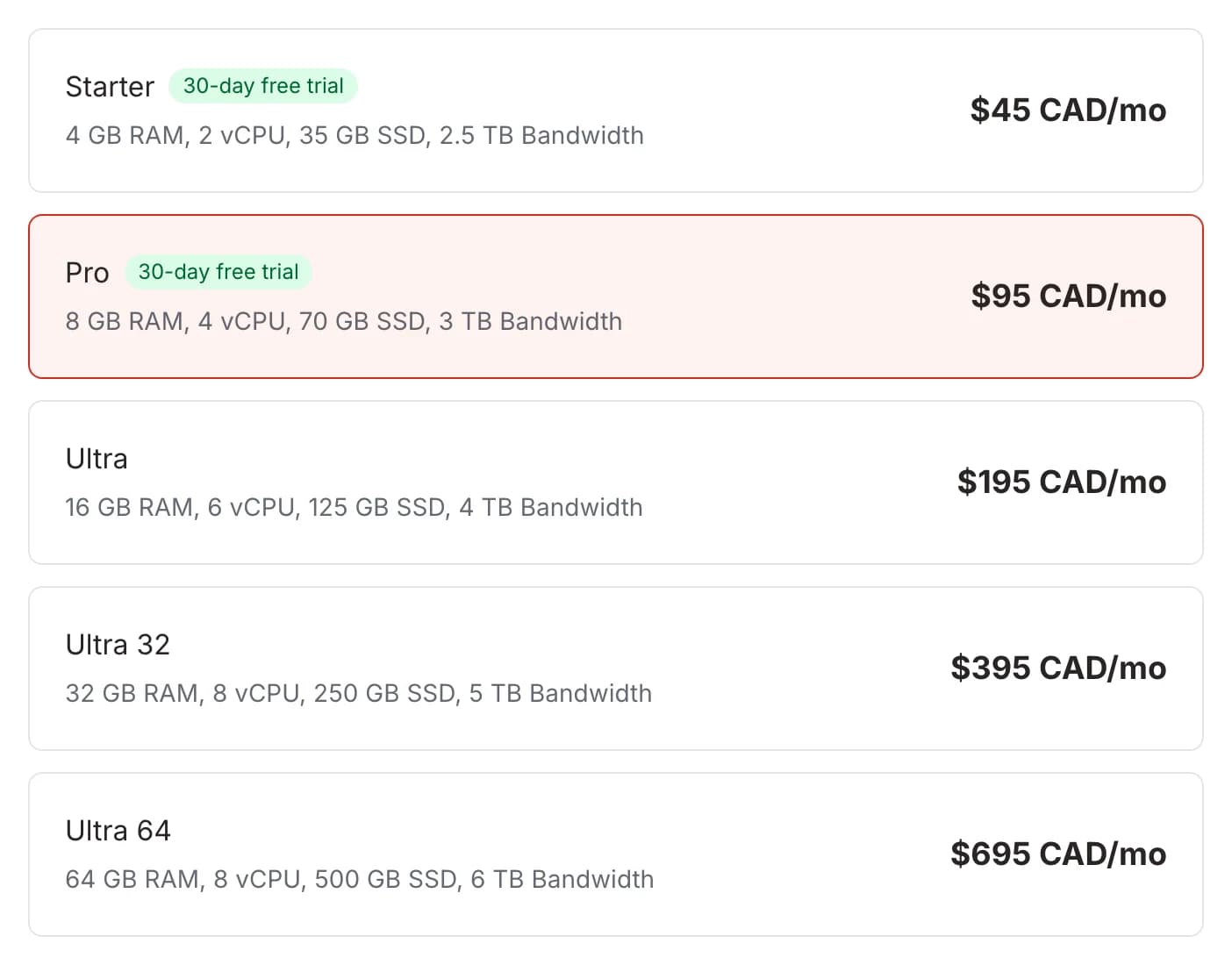
On MapleDeploy, the same setup costs $95 CAD/month on the Pro plan. All five developers deploy freely, no per-seat charge. All twenty sites share the VM. A shared PostgreSQL database is one click away. The bill is the same whether you have two developers or ten, and whether you're hosting three client projects or thirty. See our plans and pricing for the full specs breakdown.
Choose your plan
Pick a dedicated Canadian VM, provisioned in minutes. One flat price covers your frontend, backend, and databases. No per-seat charges, no bandwidth metering.
One platform, flat pricing, Canadian infrastructure
Next.js, backends, databases. Deploy them all on one VM in Toronto.